The solar system is almost impossibly big. Distances between planets are so large that even saying
"millions of miles" starts to feel meaningless. The Los Angeles Solar System Project solves this by
shrinking the whole solar system to a scale you can actually explore — and it all starts with one building.
One Dome as the Sun
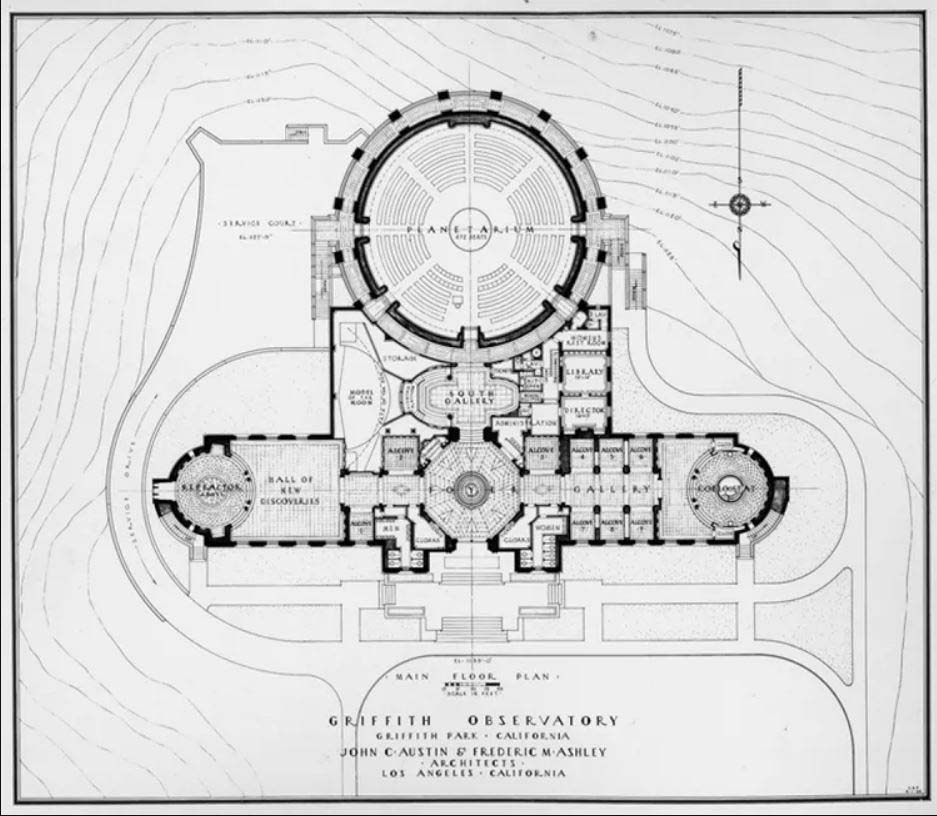
At the top of Griffith Park, the Griffith Observatory Planetarium sits under a dome that is
82 feet 10 inches across — roughly the width of a large house.
Now imagine that dome is the Sun.
The real Sun is about 865,000 miles in diameter. How many times larger is that than our 82-foot dome?
Divide, and you get roughly 55 million. That is the project's scale factor:
1 to 55 million. Every object in the model is shrunk by exactly that
amount — planets, moons, distances, all of it.
Historic plan of Griffith Observatory
How the Math Works
One inch in the model equals 55 million inches in real life — about 870 miles.
To find the model size of any object, just divide its real diameter by 55 million.
Earth is about 7,926 miles across. Divide by 55 million and you get roughly
9 inches — just about the size of a soccer ball.
The Moon? About 2,159 miles across, which works out to 2½ inches in the model —
the size of a baseball. And at the model scale, the Moon orbits only 23 feet from
the Earth. The real Moon is a quarter million miles away, so that 23-foot separation is actually
one of the most accurate things about the model.
The Planets at a Glance
All sizes and distances measured at the 1 to 55 million scale, with the
Observatory Planetarium dome representing the Sun.
Body
Model size
Distance from the dome
The Sun
82 ft 10 in dome
—
Mercury
3½ in (88 mm)
⅔ mile (1 km)
Venus
8¾ in (217 mm)
1¼ miles (2 km)
Earth
~9 in — a soccer ball
1.6 miles (2.5 km)
↳ Moon
~2½ in — a baseball
23 ft from Earth
Mars
5 in (123 mm)
2½ miles (4 km)
Ceres
⅝ in (16 mm)
5 miles (8 km)
Asteroids (Vesta)
⅜ in (10 mm)
5 miles (8 km)
Jupiter
100 in — about 8 feet (2.5 m)
9 miles (14 km)
Saturn
7 ft sphere (2.1 m); rings 16 ft (5 m) across
16 miles (26 km)
Uranus
36 in — 3 feet (91 cm)
32 miles (51 km)
Neptune
35 in (89 cm)
51 miles (82 km)
Pluto
1¾ in (45 mm)
50–83 miles (80–133 km)
Sedna
⅝ in (16 mm)
~1,500 miles (2,400 km)
Distance Is the Real Surprise
The sizes of the planets are fun to think about, but the true shock is the distances between them.
In a genuine scale model you cannot put everything in one room — or even one city.
Standing at the dome and walking toward Earth's orbit means a 1.6-mile hike. Mars is a
2½-mile trip. Jupiter — the largest planet — is 9 miles away. Saturn is 16 miles. By the
time you reach Sedna, the most distant object in the model, you need to travel
1,500 miles. That is the distance from Los Angeles to St. Louis.
And the nearest star, Proxima Centauri? At this scale, it would be floating
100,000 miles above the Pacific Ocean — nearly halfway to the real Moon.
Mostly Empty Space
What the model really reveals is not how big the planets are — it is how much of the solar
system is nothing at all.
Jupiter is the largest planet, yet its 8-foot model sphere is lost inside 9 miles of void.
Saturn's spectacular rings, the most dramatic element of the whole model, are only 16 feet
across — yet 16 miles separate them from the Sun.
Even the asteroid belt, which sounds crowded from the name, is so spread out that a spaceship
can fly straight through it without hitting anything. The model lets you feel that emptiness
at a human scale, which is something no photograph or diagram can do.
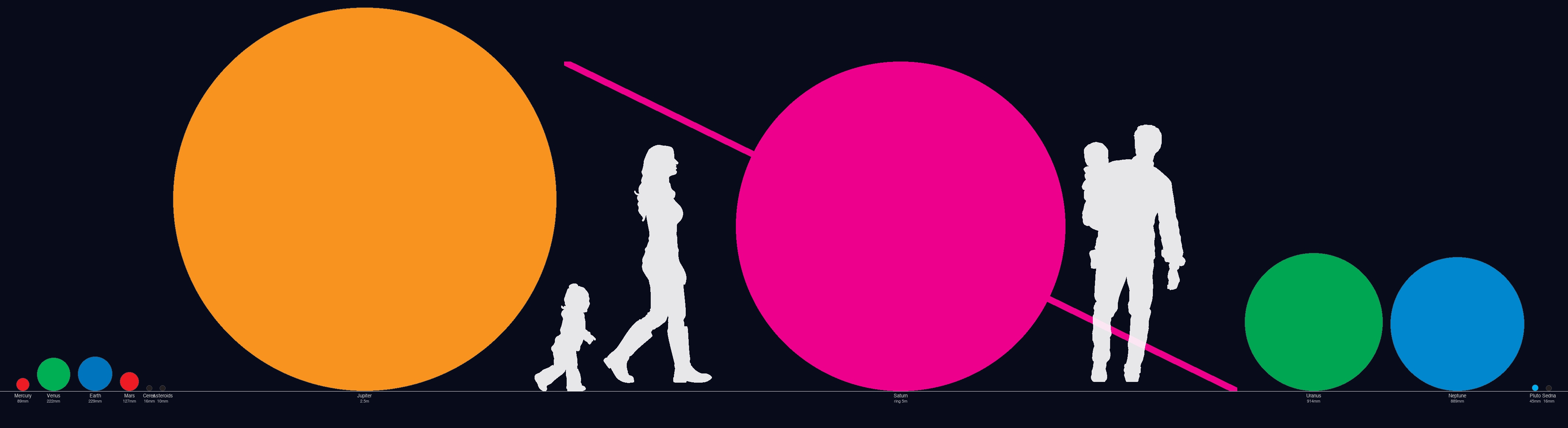
Size of Model Relative To People
Every model body shown at the same 1 to 55 million scale.
Obviously we would never see them side-by-side like this.
This perspective squeezes out all the space to convey the relative sizes of the bodies in the LASSP model compared to people.